 .
. 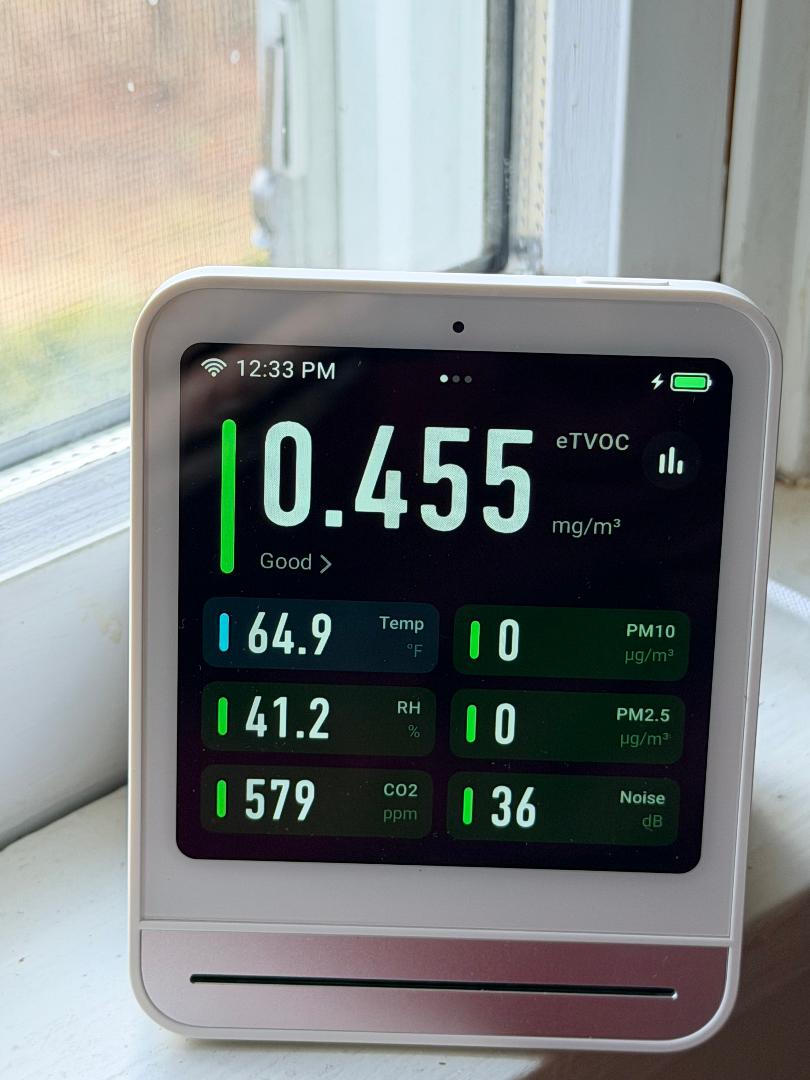
Just to wrap up loose ends, I expressed concern here in the past about the Qingping air quality monitor I'd bought and the consistently yellow ("slightly high") VOC readings I was getting from it. This won't likely be of much interest to anyone except possibly Tabs since I think he may have also picked up an air quality monitor.
I think my air is fine but it's good to know there are 2 units of measure you can choose your readings in: parts per billion, which is what I'd set mine to, initially, and mg/m3. So it's important to compare apples to apples when looking at readings. Per my research...

- Standardization: The Qingping Air Quality Monitor's onboard sensor (SGP40) is designed to align with Chinese standard guidelines that track tVOC in
.
- Actionable Advice: The monitor’s associated app provides air quality health advice (such as "avoid staying in that environment") based on
thresholds, typically defining good air quality as below.
- Conversion: While you can change the units to parts per billion (ppb) on the device, the conversion factor is approximately
(1 ppb = 0.0045)
So after reading this I changed my units to mg/m3. My readings were about 1.242 using that measurement yet is was displayed as yellow or slightly high.
TVOC Level (µg/m³ |
Meaning | What To Do |
|---|---|---|
| 0 – 300 | Good | Air is clean; normal ventilation is fine |
| 300 – 1,000 | Fair | Increase airflow |
| 1,000 – 3,000 | Poor | Remove sources and ventilate strongly |
| 3,000+ | Very Poor | Take immediate action to clean air |
- The 1-3 mg/m³ Threshold: While readings above 3 or 10 mg/m³ are considered hazardous over shorter periods, the 1–3 mg/m³ range is considered slightly elevated and is designated in yellow to indicate that, while not immediately dangerous, it is not "fine" or "excellent".
- Purpose of the Sensor: The tVOC sensor (often a SGP40 sensor) in the Qingping monitors is designed to detect a wide range of gases, including those from cleaning products, alcohol, paint, and humans themselves (breath/sweat).
- Why It's Slightly High: Even with good ventilation, it is easy for indoor VOCs to hover in this 1–2 mg/m³ range due to building materials, furniture, or perfumes.
- Automatic Calibration/Relative Measurement: The Qingping monitor uses an index to calculate VOCs, where 100 represents the average 24-hour exposure, and the unit sets its own "baseline" to 0 in clean air. A reading of 1.282 might be a reflection of your environment's relative VOC levels compared to that baseline.
So the suggestion is to open a window. I did so for just about 5 minutes; within minutes the VOC levels dropped considerably, until they were in the green zone. According to Qingping, this happens when the cause of the elevated VOC readings is "localized pollution," meaning things like furniture or chemicals inside the home.
While I do mostly have old furniture here, there are 2 exceptions on the first floor and I wonder if one or both may be the culprit:
1. I did buy a jute rug maybe 2 years ago. I suppose it could have been treated with something. Well, I'll be pet sitting again soon (in my home) so I planned on rolling up this rug and putting it away since last time the dog kind of damaged it. I can see if putting the rug in another room with door closed has any effect on the monitor. If it did, I would air out the jute rug outside for a while.
2. The other thing is that in 2022, I had board and batten wall paneling installed in my LR, DR, back hallway and stairwell. It wasn't wood; I think it may have been MDF or HDF, which I had read at the time could outgas, but that painting it (which was done) reduces, but does not eliminat, that. Could it still be outgassing 4 years later??
Found this online:
This is more than a theoretical question since I want him to extend the board and batten to my kitchen. I'm not sure he could closely replicate the look using wood, which would be thicker. Also more expensive, though that's not a priority now, especially given there are just 2 small partial walls in the kitchen to panel.
I did watch the monitor go from the green zone with the open window (<1.0) and then it slowly increased to 1.282 after I closed it. So even if the rug, wall panels and anything are outgassing, it's still only "sightly elevated." But still, it bothers me. The thing is, though, that the house is pretty closed up all winter, and once it gets humid outside, starting probably in June, the house is again closed up with central air on. So not a whole lot of time to attempt further airing out.
I also watched the monitor after my forced hot air/oil furnace kicked on; it seemed to have a slow and gradual negative effect on monitor readings. One other thing I could do, just to see what happens, is move the air quality monitor to my upstairs, which would be even further from cooking (which can elevate readings) as well as the jute rug and wall panelling.
...I just moved the monitor upstairs about 15 minutes ago. Surprisingly, VOC readings actually ROSE upstairs to a high of 1.5. Then I opened the window right next to it and it quickly dropped to about 0.37. After closing the window, it slowly rose to a high of 0.956 but is now back down to 0.598 (green zone). Let's see if it stays there, cus these reading seem all over the place!
I also reached out to Qingping customer service to see if they could shed any further light on this.
March 14th, 2026 at 06:31 pm 1773513110
I would also very very interested to hear more about the new pet you will be fostering?
As for MDFs, I’ve worked with them in the past, and yes indeed, I also quickly stopped using them after realizing how strong the formaldehyde off-gassing is. It is a terrible wood to work with imo.
That said, I think it’s very possible that there are more than one source of off-gassing in your house? Hopefully, you will be able to figure it all out, and even implement a reasonable fix for all that.
March 15th, 2026 at 01:20 pm 1773580800
March 15th, 2026 at 09:41 pm 1773610860
March 15th, 2026 at 11:16 pm 1773616594
March 15th, 2026 at 11:32 pm 1773617533